Birds of a Feather SIGGRAPH 2025

This informal blog-style publication serves as an archival report for the Birds of a Feather on Sustainable Research in Computer Graphics, organized at Siggraph 2025 in Vancouver. The co-organizers team for this event was composed of Felix Hänhlein (University of Washington), Maria Larsson (The University of Tokyo), Chenxi Liu (University of Toronto), Ruben Wiersma (ETH Zurich), and myself, Emilie Yu (UCSB).
The goal of this document is to serve as a reference point for attendees and other community members who would like to learn more about this topic. This is the second time a BoF on this topic is present at Siggraph (see the first BoF report). We are excited to continue growing the community around the BoF in future conferences and events! If you would like to participate in organizing these events, or have ideas for more initiatives, feel free to reach out to us!
Summary
The birds of a feather session was held in a small room with round tables around which people could sit in small groups. The attendees were a mix of graphics researchers, industry practitioners, and educators. People were from different countries, representing Central and North America, Asia, Oceania, and Europe.
The round-table discussions aimed at offering each attendee space to reflect and express their thoughts on the topic of sustainability in graphics research or practice. We chose this format to foster more intimate and less intimidating forms of exchange and discussion, to encourage people to participate and get involved regardless of their current level of expertise on the topic. The organizing team took up a role of discussion facilitators, rather than imparting knowledge on attendees.
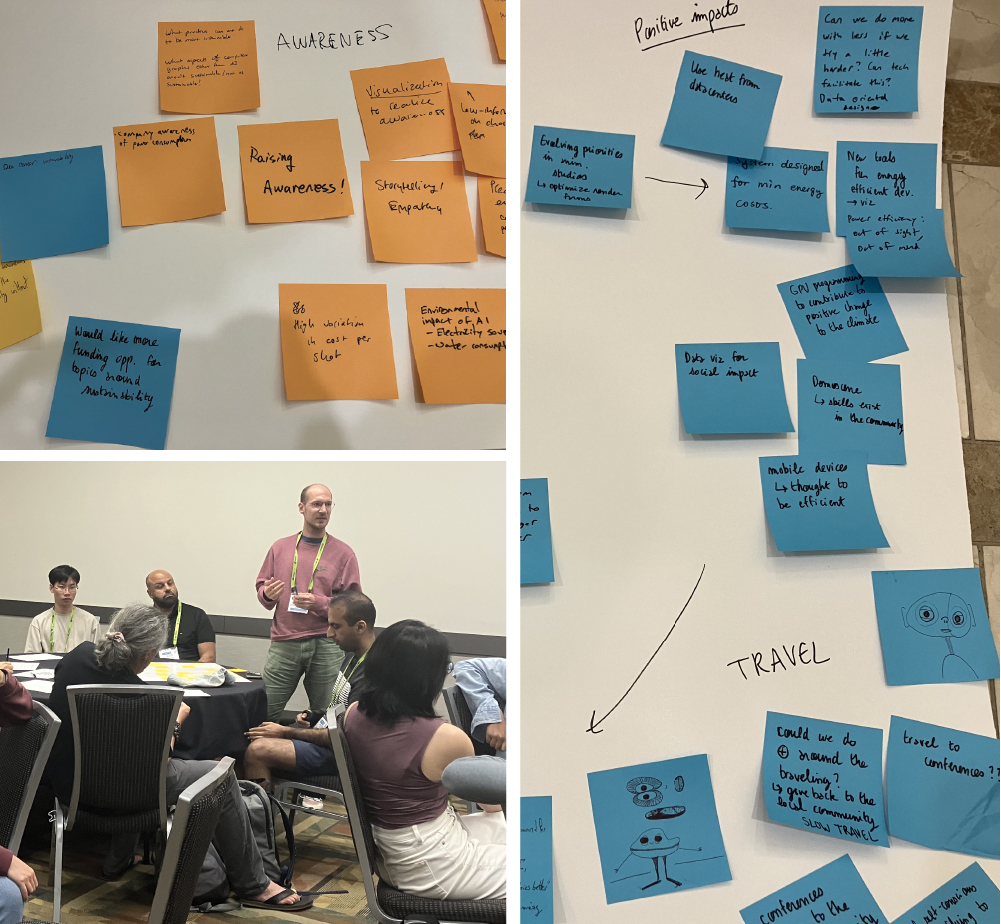
Roundtable discussions, post-it notes for personal reflections and sharing.
We loosely followed this format:
- Introduction speech & explaining the activity (5min)
- Personal reflection time + post-it writing (3min)
- Round-table discussion + building post it boards (30min)
- Sharing discussion outcomes with everyone (10min)
Outcomes
In each section, we first report the themes and specific topics that people discussed during the event, grouping across tables. The themes relate and organize thoughts that participants expressed, but they are analyzed through the lens of the authors’ situated point of view on the matter. We do not claim that all attendees unanimously agree with what we report here. At the end of each theme we (the organizing team) provide additional references and resources to guide interested readers in engaging further with these questions.
Systemic issues in current research/industry focus
- Forced growth of AI-related methods in research and industry:
- academic researchers expressed concerns about the push for growth of model scale, and the induced growth in compute necessary. This translates to very real constraints and incentives in researchers’ work, such as feeling obligated to run comparisons on power-hungry models to stand a chance at getting a work published.
- industry practitioners also feel incentives to engage with / use ML technology, regardless of the impacts
- attendees point out the lack of clear understandable benefit to this growth, especially when put in perspective with the detrimental environmental impacts. “What problem are we trying to solve with bigger resolution, bigger ML models?”
- Profitability VS sustainability: attendees worry about the limits of pushing for sustainability within capitalistic companies that will prioritize profits. There is an essential need to develop and enforce constraining measures (e.g. at the scale of reviewing committees, or of governmental entities) to counter unchecked market forces.
- Computer graphics research (at Siggraph in particular) is historically biased towards impressive results (“wow effect”), which fosters a culture of always using more compute resources.
Ressources
- In Human-Computer Interaction (HCI, a closely related field of work to CG), researchers have questioned the (too often implicit) neo-liberal political stance that impacts the research that is conducted:
- The political economy of computing: the elephant in the HCI room. Hamid and Bonnie. Interactions 2015. https://dl.acm.org/doi/10.1145/2832117
- HCI and environmental sustainability: the politics of design and the design of politics. Dourish. DIS 2010. https://dl.acm.org/doi/10.1145/1858171.1858173
- Human-Computer Insurrection: Notes on an Anarchist HCI. Os et al. CHI 2019. https://dl.acm.org/doi/10.1145/3290605.3300569
- In other communities (HCI, ML), there are dedicated conference tracks or venues to publish work that applies a meta and critical lens on research practices in the community, or directly engages with societal issues and how they relate to the field:
- There are rising efforts within the CG/Siggraph community to push forward work that engages with societal issues:
- Countering racial bias in computer graphics research. Kim et al. Siggraph Talk 2022. https://dl.acm.org/doi/10.1145/3532836.3536263
- Sex and gender in the computer graphics research literature. Dodik and Sellán et al. Siggraph Talk 2022. https://dl.acm.org/doi/10.1145/3532836.3536227
- Woke Dataviz: Equitable Data Design For Visualizing People And Social Outcomes. Holder. Siggraph Course 2025. https://dl.acm.org/doi/full/10.1145/3721241.3736523
- Gender Diversity of Graphics Conference Leadership. Jacobson. SIGGRAPH Talks ‘24. https://dl.acm.org/doi/fullHtml/10.1145/3641233.3664309
How to mitigate negative impacts?
- Measuring negative impacts:
- there is an urgent unmet need to develop methods to measure and monitor negative impacts (e.g. energy consumption of a render, or along the development of a research paper)
- developing these methods constitute a research challenge: how to measure impacts? how to develop metrics that can put in perspective quality gains with accrued environmental impact?
- we need ways to enforce measurements of impacts and use these to either raise awareness or enforce standards (e.g., at the level of reviewing committees, at the governmental level)
- Effecting personal VS institutional change: we identify the importance of acting at different scales, in particular at the collective scale (company, research community). All attendees come from different institutional and political contexts, hence there is obviously no single answer that works for everyone. Each individual faces different barriers and constraints towards effecting change.
- Other avenues that are tangential to CG industry/research:
- re-using data center heat for heating
- sharing hardware resources at larger institutional scales (e.g., across labs in the same university, across universities in the same country)
Ressources
- Some co-organizers of this BoF took part in a recent work on quantifying a posteriori the type of hardware used in Siggraph papers: Towards a sustainable use of GPUs in Graphics Research. Yu and Michel et al. Siggraph Talk 2025. https://dl.acm.org/doi/10.1145/3721239.3734084
- An attendee pointed out to us that french animation studios have put together collective initiatives to reduce environmental impact:
- A tool to report carbon impact of animation production https://carbulator.org/login (this tool has been adopted by the French National Centre of Cinema for defining carbon reports that are mandatory to receive grants from this public agency).
- Guides on how to shift practices in the industry towards more sustainable behaviors: https://ecoprod.com/guide-de-lanimation-eco-responsable/
- Some studios have already started reporting their carbon impact reports online: eg https://ooolala.fr/en/eco/
- We also want to highlight the efforts around the Xbox Sustainability Toolkit: https://developer.microsoft.com/en-us/games/articles/2023/03/gdc-2023-xbox-sustainability-toolkit-for-game-creators/
- Rulon Raymond and his team presented a report at Siggraph 2025 about their efforts to reduce energy consumption during Call of Duty gameplay without affecting the gamer experience. See: Embracing Greener Graphics Practices in Call of Duty®. Raymond. Siggraph Talk 2025. https://dl.acm.org/doi/10.1145/3721239.3734071
How to apply graphics research/tools towards sustainable outcomes?
- Topics in graphics sub-fields that can support sustainable practices:
- fabrication: reduce material usage and waste
- real-time graphics, mobile graphics, demoscene shaders: developing rendering techniques that are energy-efficient, or can run on low-end hardware (more robust to hardware obsolescence)
- data visualization: raise awareness, make numbers and effects more visible/understandable for the general public, or practitioners
- graphics tools for non-graphics purposes: heat transfer simulations, shape optimization to reduce energy loss/consumption
- Risks of rebound effect: once a more efficient technology exists, this can back-fire and cause in turn people to use the technology more, cancelling the efficiency gains.
- Some attendees mentioned wanting to broaden what kind of topics CG research can tackle
Ressources
- Non-exhaustive list of examples of recent research papers that leverage CG techniques to contribute to more sustainable outcomes:
- DualMS: Implicit Dual-Channel Minimal Surface Optimization for Heat Exchanger Design. Zhang et al. Siggraph 2025. https://dl.acm.org/doi/full/10.1145/3721238.3730700
- Rags2Riches: Computational Garment Reuse. Qi et al. Siggraph 2025. https://dl.acm.org/doi/10.1145/3721238.3730703
- SustainaPrint: Making the Most of Eco-Friendly Filaments. Perroni-Scharf et al. UIST 2025. https://dl.acm.org/doi/10.1145/3746059.3747640
- Refashion: Reconfigurable Garments via Modular Design. Lin et al. UIST 2025. https://dl.acm.org/doi/10.1145/3746059.3747632
- HCI has a longer history of work that aims at achieving more sustainable outcomes, so it is worth reading about how this community engaged with different approaches, and navigated the limitations and hurdles in this space (notably, the rebound effect, and the limits of raising awareness about individual practices). These papers do a good job at summarizing these developments:
- Mapping the landscape of sustainable HCI. DiSalvo et al. CHI 2010. https://dl.acm.org/doi/10.1145/1753326.1753625
- Have We Taken On Too Much?: A Critical Review of the Sustainable HCI Landscape. Bremer et al. CHI 2022. https://dl.acm.org/doi/10.1145/3491102.3517609
Organizing the global community differently
Many attendees raised the question of air travel, that is necessary to engage with the global research communities in international conferences. We discussed alternative solutions:
- slow down travel: if we travel far somewhere for a conference, can we do more instead of just coming for the days of the event? Can we engage more with the local research communities?
- take inspiration from remote conferences during covid: this showed us it is possible (albeit difficult) to function remotely
- local mirror conferences: can we build more distributed models for conferences to avoid the furthest travels?
References
Other communities are currently experimenting distributed models for conferences:
- EurIPS: European satellite event of NeurIPS 2025 https://eurips.cc/
- para.CHI: Hubs for CHI 2024 https://aspirelab.io/parachi/#about
- LIMITS: fully virtual workshop, with viewing hubs across the world https://computingwithinlimits.org/2025/
Future improvements
We are excited to see more BoF and community events around the topic of sustainable research in graphics in the future. We will aim to evolve the format in order to better suit the needs of attendees. In particular, here are a few perspectives for improvement:
- Include an informative section to the event (e.g., short talks on different topics) to guide discussions into more concrete and actionable topics
- Build longer-term community spaces for people to keep exchanging after the BoF is over
- Grow the event to a larger audience – and in particular to people who are less aware or interested in the topic